
A lightweight recycled polyester jacket fabric can look promising on a swatch card and still be the wrong choice for a bulk order. For clothing brands and uniform buyers, the useful question after Performance Days 2026 is what the complete material system can deliver—and what the supplier can document.
The October awards offer a practical starting point. One recognized material combines a recycled polyester face fabric with a polypropylene membrane. Below, we separate the reported specification from the decisions buyers still need to make about construction, testing, branding and production.
Performance Days 2026: What jacket fabric buyers should take from the news
The organizer lists the Munich fair for October 13–14, 2026. Its October 2026 awards page names FLYTEC DEFEND as the Performance Award winner and describes a stretch polypropylene membrane system for technical outerwear. This is an organizer description, not an independent test report.
Sportstextiles reported on October 13 that the membrane is bonded to an 89 GSM fabric made entirely from recycled polyester. That wording identifies the fabric component; it does not establish the weight or recycled percentage of every component in the composite.
The procurement lesson is to request component-level specifications before comparing suppliers. An award can justify investigating a material. It cannot replace checking the exact article code, production availability, testing and suitability for your garment.
What does 89 GSM mean for a recycled polyester jacket fabric?
GSM means grams per square meter. It describes mass per unit area, not the weight of a whole jacket. Ask suppliers to distinguish the face fabric, membrane, adhesive, backing and separate lining on their specification sheets.
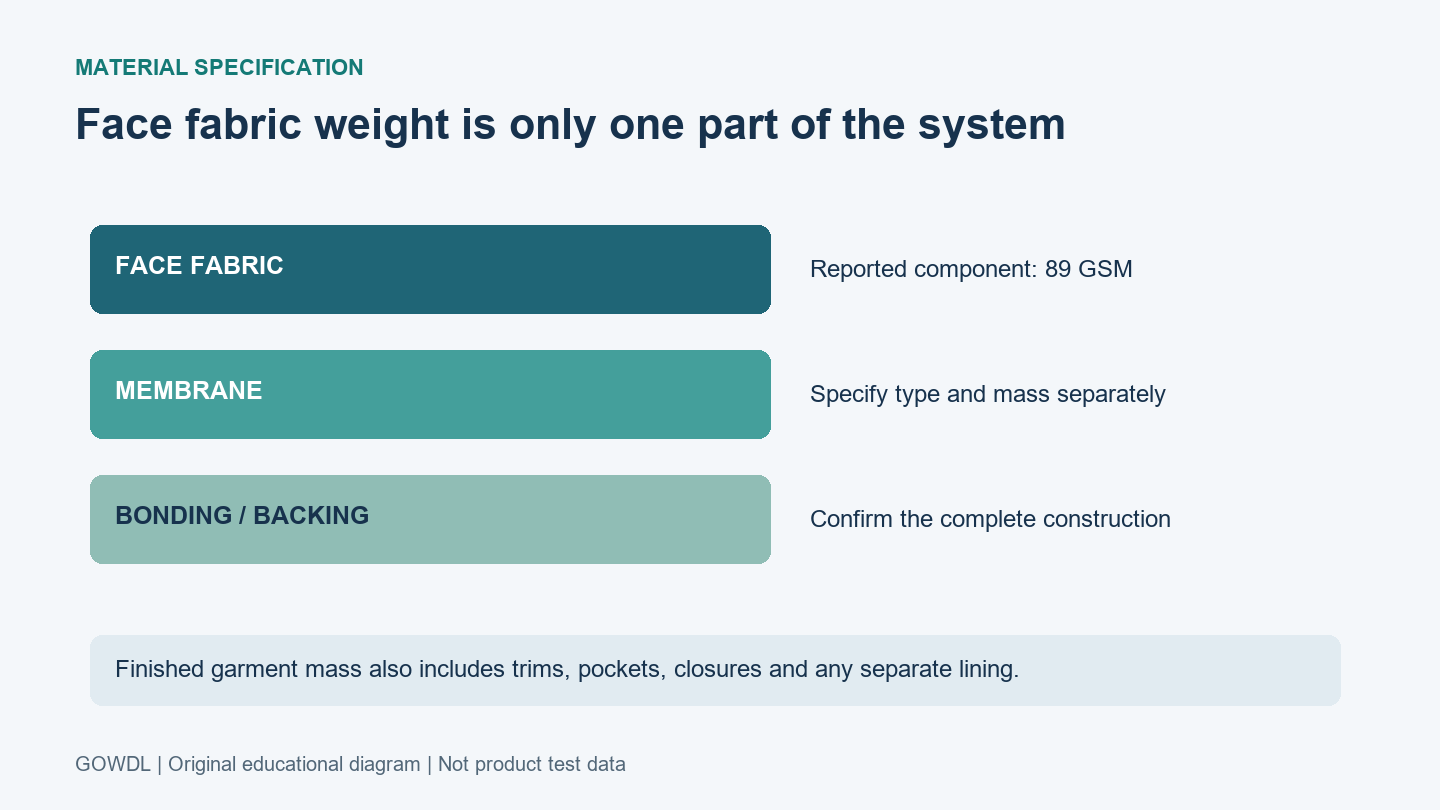
A simple hypothetical calculation shows why the distinction matters. If a cutting plan consumed 2 square meters of an 89 GSM face fabric, that component would account for 178 grams before cutting losses. Membrane, bonding, pockets, zippers, lining and other parts would add mass. This example is arithmetic, not the consumption or weight of a real jacket.
When two quotes show different weights, first check whether both numbers describe the same construction. A lighter face fabric should be evaluated against the intended use, rather than treated automatically as either a quality improvement or a durability problem. For background on terminology, see the GOWDL fabric guide.
Which test reports should buyers request?
Build the test plan around the selling claim. A jacket offered for occasional wind exposure needs a different approval brief from a product marketed for sustained rain. Put the required method, units, specimen construction and acceptance criteria in the purchase specification.
| Question | Evidence to request | Comparison mistake to avoid |
|---|---|---|
| Will the fabric resist water penetration? | Hydrostatic-pressure report, method, units and sample identification | Treating a water-beading demonstration as the complete waterproofness assessment |
| How was moisture transfer assessed? | Named method, conditions, units and tested assembly | Ranking different test methods on a single numerical scale |
| What happens after care? | Agreed wash procedure and results after the specified cycles | Comparing an unwashed sample with a washed one |
| Will the garment survive its use? | Relevant tear, abrasion, seam and bonding checks | Approving the whole garment from a face-fabric swatch |
| What supports the recycled claim? | Component composition and applicable chain-of-custody evidence | Calling the entire jacket recycled because one layer is recycled |
Water penetration and surface repellency
ISO 811:2018 specifies a hydrostatic-pressure method for assessing fabric resistance to water penetration. It is a test method, not a blanket pass mark for every jacket. Agree the target with your laboratory and intended application; also specify whether the report covers the fabric or a garment assembly.
For a rainwear project, ask the garment supplier how seams, zipper areas and pocket entries will be evaluated. Do not infer finished-garment protection from a fabric report alone. Keep the approved material and the finished sample together so later substitutions are easier to detect.
Breathability figures need a method attached
ISO 11092:2026 covers measurement of thermal and water-vapour resistance under steady conditions. Its public scope also cautions that those conditions do not represent specific comfort situations. If a quote uses an MVTR figure instead, obtain the actual test method and conditions rather than attempting a direct comparison with a resistance result.
Choose a construction for the job, not just the trend
The following is a buyer planning framework, not a suitability certification for the award-winning fabric. Use it to write a brief before asking for samples.
| Application | First priority | Sample approval focus |
|---|---|---|
| Packable travel shell | Required protection within the packed-size target | Pack and unpack repeatedly; check finish, closure and storage design |
| Active team jacket | Movement, fit and moisture-management requirements | Reach, bend and wear-test with the intended base layer |
| Outdoor staff uniform | Care routine, pockets and expected exposure | Check access to tools, logo areas and laundering instructions |
| Repeated-contact workwear | Wear zones and construction durability | Evaluate elbows, shoulders, pocket corners and relevant reinforcement |
For example, an outdoor event team might need a compact jacket that fits over its uniform and keeps identification visible. A maintenance team may place greater weight on pocket security and contact wear. Neither brief is adequately expressed by asking for “the lightest recycled fabric.”
GOWDL’s custom jacket manufacturing page is a starting point for discussing a development brief. For a faster comparison using existing styles, browse ready-stock clothing options and request the current specifications of the shortlisted jacket. Availability, material composition and test evidence need confirmation for each style.
A sourcing workflow from swatch to bulk approval
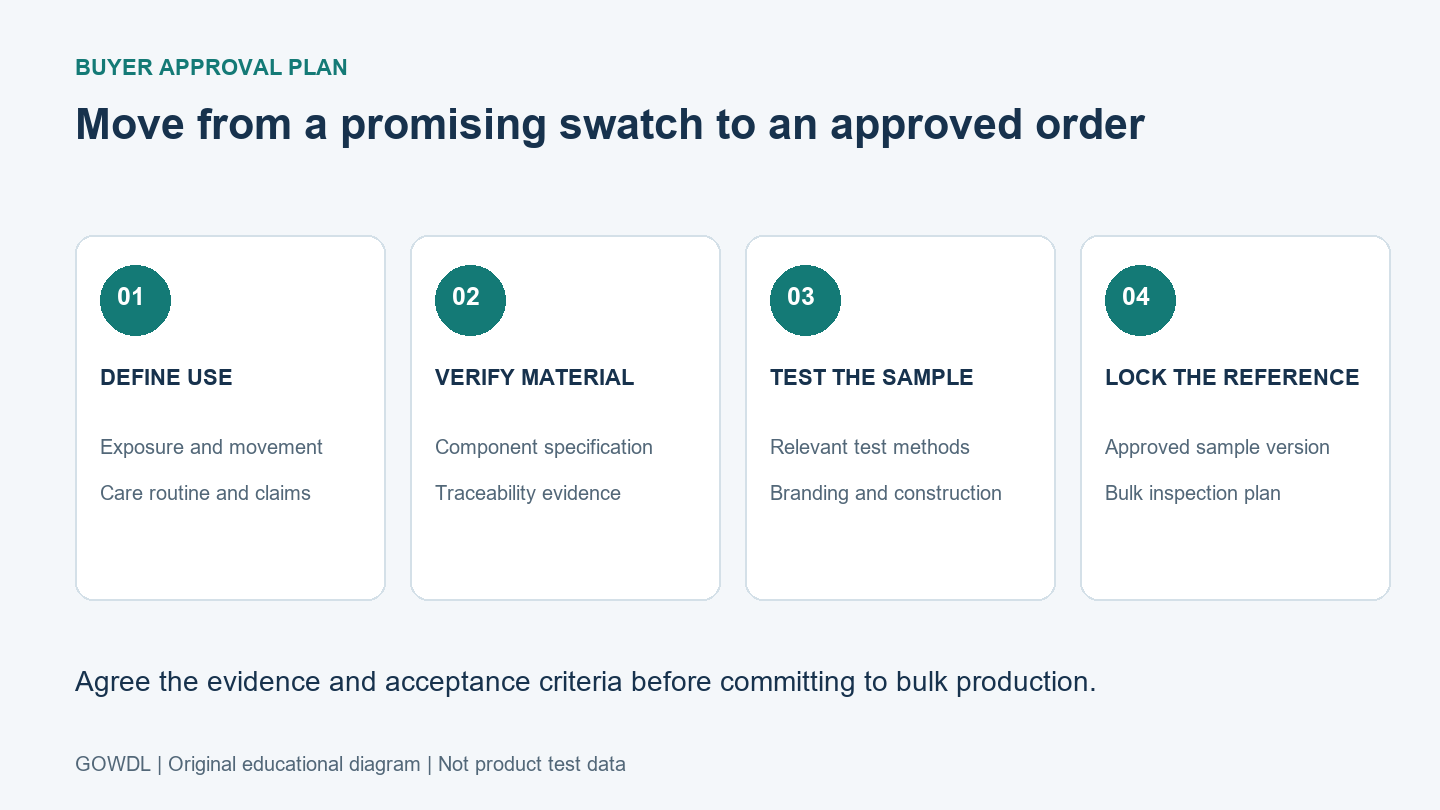
1. Send one specification to every supplier
Define the end use, size range, construction, color, branding and care requirements. Request face-fabric and finished-composite weights separately, together with usable width and tolerances. Have suppliers quote the same delivery basis, packaging and test requirements; otherwise, the lower unit price may simply exclude work included elsewhere.
2. Verify recycled-content documentation
Textile Exchange’s Content Claim Standard describes traceability supported by scope and transaction certificates. For your project, check the applicable standard, certificate scope, seller and shipment documentation. A supplier’s general certificate should not be treated as evidence that every offered fabric article is covered.
Also ask how the claimed percentage is calculated. A recycled face fabric plus a different membrane is not automatically an entirely recycled composite or garment. Approve product-page and label wording against the documentation for the actual construction.
3. Approve decoration on the proposed material
Include the intended logo method in the sample order. Ask the supplier to assess embroidery, printing or transfer suitability on that construction and record the agreed process. Examine the decorated area after the intended care procedure. If weather protection is part of the claim, include that area in the relevant evaluation rather than approving appearance alone.
4. Keep a signed reference before production
Record the fabric article, approved color, measurements, components, artwork and test plan against one sample version. Agree how a proposed material or trim change will be approved. Keep a retained sample for the order and an inspection record linked to the production batch.
RFQ checklist you can copy
- End use, destination market and intended product claims
- Order quantities by color and size; sample and bulk delivery dates
- Face-fabric composition and GSM; complete laminate construction and GSM
- Performance methods, units, targets, conditioning and care requirements
- Recycled-content documentation and proposed label wording
- Logo process, placement, pocket layout and closure details
- Sample version, inspection requirements and substitution approval process
Frequently asked questions
Is 89 GSM enough for a waterproof jacket?
GSM alone cannot answer that. In this news item, the figure refers to the reported fabric component. Evaluate the complete construction, supporting reports and finished garment against the intended claim. Do not assume that another 89 GSM fabric will perform like the recognized material.
Does recycled polyester mean the whole jacket is sustainable?
No single component establishes the impact of the whole product. Keep the claim specific to the documented material and percentage. Consider the other components, intended service life, care requirements and evidence behind any broader environmental statement. Recycled content and finished-product recyclability are separate questions.
Can GOWDL supply this exact award-winning material?
This article does not establish that GOWDL stocks or supplies FLYTEC DEFEND. Send the required construction and performance brief to discuss available options. Any proposed material, supplier documentation, production timing and testing must be confirmed for the specific order before purchase.
Turn the news into a better jacket specification
Performance Days 2026 provides a useful prompt to investigate lightweight recycled polyester jacket fabric. The purchasing decision still depends on a complete specification, comparable evidence and an approved garment. Start with the use case, then select the material that can support it.
Planning outerwear for your own brand or team? Explore GOWDL’s custom jacket manufacturing solutions, or compare current ready-stock options. Share your intended use, quantities and required performance so the discussion begins with a practical brief.
Sources checked October 15, 2026. News facts are attributed above; the sourcing workflow and hypothetical calculation are editorial guidance. No independent testing of the named award-winning material is claimed.
