
Polartec Alpha 2026 puts a useful question in front of jacket and hoodie buyers: how should insulation perform when the wearer keeps switching between movement and rest? A product brief that specifies only fabric weight or “extra warmth” leaves that question unanswered.
Polartec’s latest announcement gives brands a news hook, but the purchasing decision still comes down to the exact material, garment construction and evidence. Here is how to turn the update into a practical development brief without confusing a branded technology with a generic fleece or an unverified supplier offer.
What Polartec announced in October 2026
In its October 13 company news release, Polartec, a Milliken & Company brand, introduced a new Alpha construction with a patent application pending. The company says the update improves resistance to snagging and fiber shedding while maintaining the open structure central to the platform.
The announcement also describes a wider selection of constructions, textures and weights. It says more than eleven brands were preparing products using the updated platform. These are attributed company statements; the release does not provide a universal percentage improvement or an independent side-by-side test dataset for every article.
For a buyer, the immediate action is to identify which generation and article code a supplier is quoting. An older fabric, another Polartec product and an unbranded insulation cannot be treated as the same material simply because all are described as lightweight or breathable.
Active insulation vs fleece vs polyester padding
Polartec’s Alpha product page describes lofted fibers and a mesh core intended to balance insulation with air exchange. This is a passive textile structure, not an electronic temperature controller. Actual comfort still depends on the surrounding layers, fit, activity and conditions.
Use the table below as a purchasing-question framework. It does not rank all products in a category or assign measured performance to GOWDL garments.
| Option | Questions for the supplier | Sample decision |
|---|---|---|
| Branded active insulation | Which article and version? What construction and evidence support the intended use? | Evaluate movement-to-rest transitions with the proposed outer layer |
| Conventional fleece | Which knit, pile, finish and weight? What reports cover care and surface durability? | Compare hand feel, fit, moisture comfort and appearance after care |
| Polyester padding system | Which insulation, shell, lining and quilting arrangement are quoted? | Check warmth needs, mobility, bulk and construction stability together |
| Hybrid construction | Which zones use each material, and how are the joins and transitions made? | Check whether the combination meets the specific activity brief |
A team standing outside for long periods and a team repeatedly lifting, walking and stopping may need different products. Start with those use patterns. Do not reject padding, approve fleece or specify active insulation solely because one category is fashionable.
Choose a garment system, not an isolated swatch
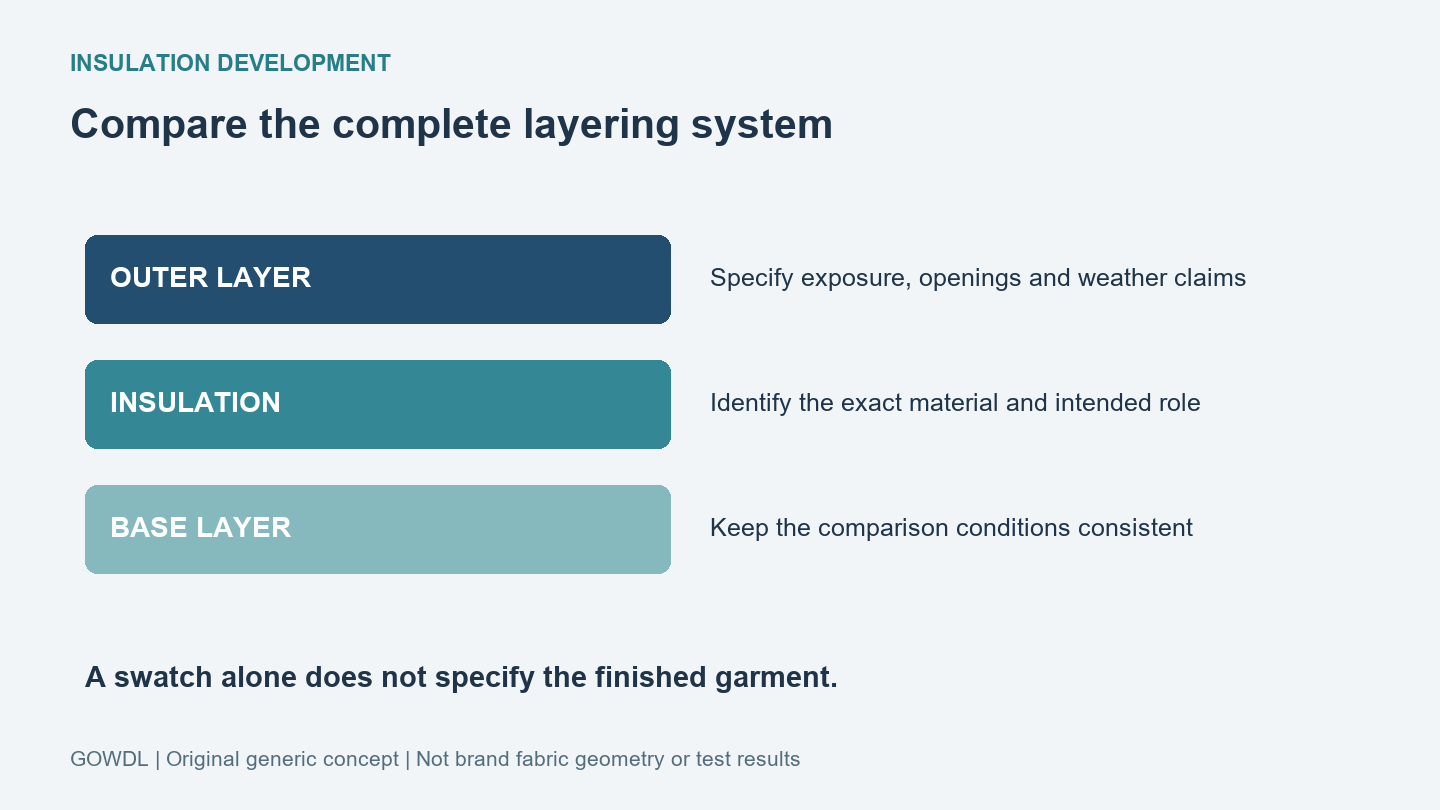
An open insulation sample tells you little about the finished garment if the proposed shell and lining are missing. Ask suppliers to show the complete assembly and explain the role of each layer. For a hoodie intended as an exposed midlayer, assess surface contact and snag exposure as part of the brief.
Separate insulation needs from weather protection
Write down whether the product is a midlayer, an outer garment or part of a layered kit. If a weather claim is required, specify how the shell, openings and seams will be evaluated. Do not infer waterproofness from moisture-management language about an insulation fabric.
For further context, GOWDL’s jacket fabric sourcing guide explains why face-fabric weight and finished construction are different specifications. That distinction also applies when comparing an insulation layer with the mass of a complete jacket.
Use GSM as an input, not a comfort rating
Ask for the mass per unit area of each specified fabric, then record the finished garment weight for the approved size. Two materials with the same GSM can have different structures. Avoid converting a fabric-weight number into a temperature rating or assuming equal-weight samples must feel equally warm.
Instead, define what the wearer does, the expected layering arrangement and the care routine. Compare samples against that brief. Let the agreed evidence determine the acceptance criteria rather than choosing a threshold after seeing the results.
What evidence should a jacket or hoodie buyer request?
A strong sample plan links each intended claim to a named method or a defined evaluation. Ask for the report date, specimen identity, test conditions and results before comparing suppliers. If a claimed improvement is against an earlier generation, identify the reference article and comparison conditions.
| Approval topic | Evidence to request | What remains to check |
|---|---|---|
| Thermal and moisture behavior | Relevant method, tested assembly, conditions and units | The intended whole-garment layering and activity pattern |
| Snagging and surface wear | Named method and results for the exact material | Contact zones such as straps, pocket edges and cuffs |
| Shedding or fiber loss | Defined evaluation and any comparison material | Whether evidence supports the precise claim being proposed |
| Laundering stability | Agreed care procedure, cycles and dimensional results | Fit, surface appearance, joins and closures after care |
| Decoration compatibility | Trial using the intended logo process and placement | Appearance, local stiffness and any relevant performance effects |
ISO 11092:2026 describes measurement of thermal and water-vapour resistance under steady conditions. Its scope does not turn a laboratory result into a guarantee of comfort in a particular real-world situation. Discuss the appropriate test plan with the laboratory and keep laboratory comparison separate from garment wear evaluation.
Run a repeatable movement-and-rest sample check
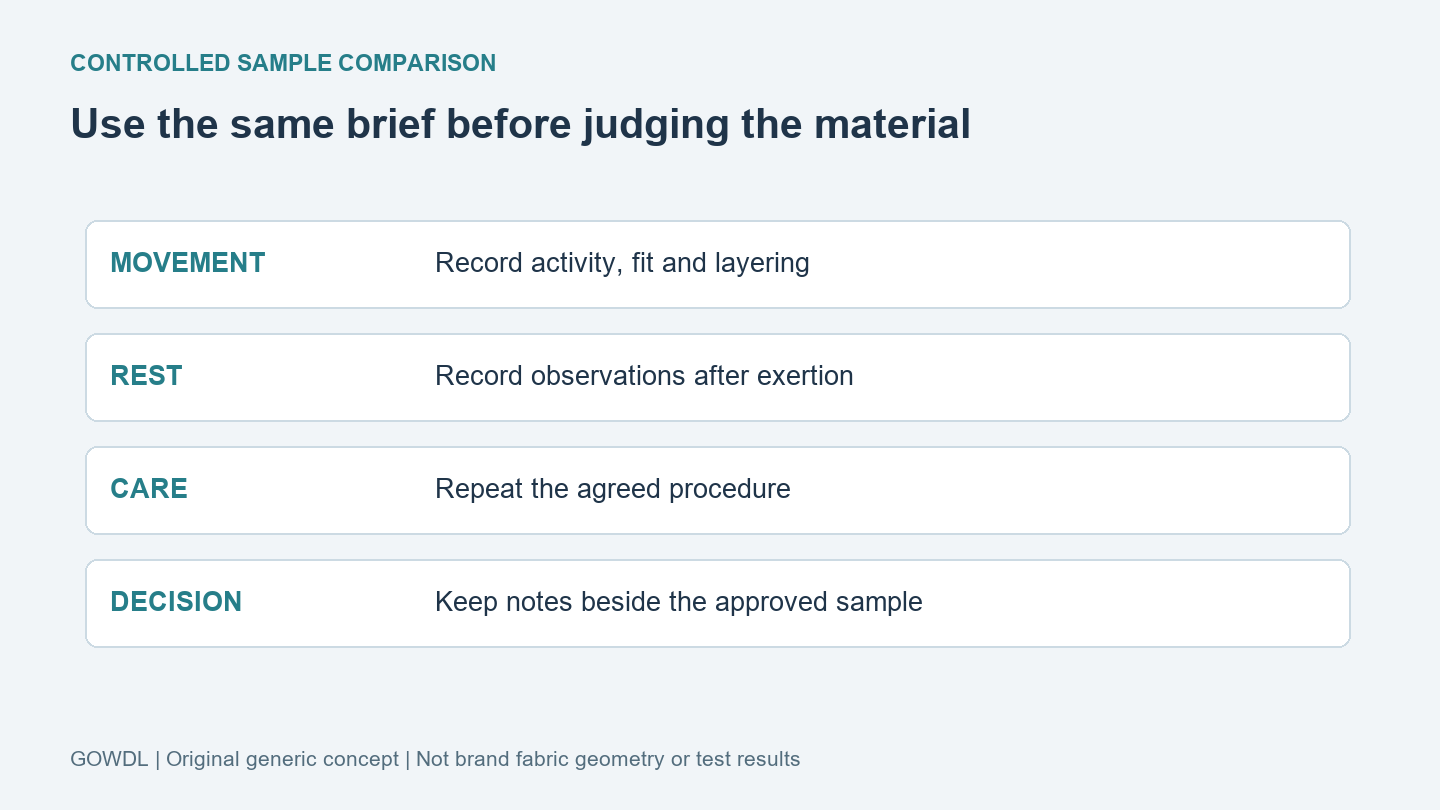
For an illustrative evaluation, ask the same wearer to compare candidate garments with the same base layer and outer shell. Record the activity, duration, conditions and observations during movement and rest. This is a development check, not a clinical study or certification test.
Keep the pattern and fit consistent where possible so a tight sleeve or different hem opening does not obscure the material comparison. Record issues rather than converting subjective impressions into invented performance percentages. Repeat the agreed checks after the approved care procedure when relevant.
Build an RFQ that suppliers can quote consistently
- Product role: exposed hoodie, insulated jacket, midlayer or hybrid design.
- Intended activity pattern, layering arrangement and required claims.
- Exact insulation article or clearly described alternative, composition and weight.
- Shell, lining, panels, closures, pockets, fit and measurement tolerances.
- Test methods, sample conditioning, care procedure and acceptance criteria.
- Branding process, placement, labels, packaging and necessary approvals.
- Order quantities, colors, size mix, delivery basis and reorder requirements.
If genuine Polartec material is essential, require the supplier to confirm the proposed sourcing route, fabric identity and applicable branding permissions. Do not substitute an unbranded product while retaining the Alpha name in the quotation or product copy.
For an own-label project, GOWDL’s custom jacket manufacturing page is a starting point for a construction brief. You can also compare ready-stock clothing options for a separate stock-based purchase. Current stock, special fabrics, test evidence and production feasibility require confirmation; these links do not establish access to Polartec Alpha.
Frequently asked questions
Is Polartec Alpha the same as any breathable fleece?
No. Alpha is a branded material platform. A generic fleece may be evaluated for the same intended use, but that does not establish the same construction or performance. Compare identified articles and supporting evidence, and describe alternatives accurately in the purchase order and marketing.
Does the 2026 update guarantee no snagging or shedding?
The company announcement describes improved resistance, not a guarantee that these effects cannot occur. Ask for the relevant evidence and intended application limits for the exact article. Avoid rewriting an improvement claim as an absolute promise about every garment or use condition.
Can GOWDL manufacture with this exact material?
This article does not confirm availability, an authorized supply relationship or use of Alpha in current GOWDL products. Submit the fabric requirement, design and quantities for a feasibility discussion. Confirm material sourcing, permitted branding and supporting documentation before committing to a branded-material order.
Turn the 2026 update into a better product brief
Polartec Alpha 2026 highlights an important sourcing issue: insulation must be considered alongside activity, garment design and durability requirements. Use the news to improve the questions in your RFQ, then let the identified material, test evidence and approved sample support the final decision.
Looking for custom performance apparel for your own team or brand? Explore GOWDL’s custom outerwear manufacturing solutions or review ready-stock options. Share the intended use and performance brief so the available construction routes can be assessed.
Sources checked October 16, 2026. Product-update statements are attributed to Polartec. Polartec and Alpha names identify third-party technology; no affiliation, authorization or GOWDL supply availability is implied. Diagrams, RFQ guidance and the sample scenario are original editorial material.
