
U.S. Regen Cotton’s new results give apparel buyers a reason to ask more precise sourcing questions. For a cotton polo or T-shirt order, the priority is connecting the claimed fiber to your actual fabric and approved product wording. An environmental headline does not replace that work.
This guide explains the October 2026 announcement, the difference between regenerative and organic cotton, and the documents and garment checks brands should request before committing to production.
What U.S. Regen Cotton announced in October 2026
On October 15, the U.S. Cotton Trust Protocol released initial U.S. Regen Cotton outcomes at the Textile Exchange Conference in Vancouver. Its official announcement describes a pilot covering 59,094 harvested acres and 469 fields in seven U.S. cotton-growing states.
| Reported indicator | Change against the program’s stated baseline |
|---|---|
| Greenhouse gas emissions | 20% lower |
| Soil carbon sequestration | 30% higher |
| Soil loss | 75% lower |
| Irrigation water-use efficiency | 49% higher |
These are program-reported agricultural results. They are not a life-cycle assessment of a finished polo shirt, an industry-wide average, or evidence about GOWDL’s current inventory.
Read the baseline before repeating a percentage
The 2025/26 measured-outcomes report describes validated field information, scientific modeling and satellite monitoring. Its baseline note distinguishes reductions, compared with Trust Protocol data including fields without soil-health practices, from carbon removals, compared with a national MRV dataset that includes both regenerative and non-regenerative practices.
The report expresses irrigation efficiency as cotton output per volume of irrigation water. A 49% increase in that ratio does not mean a garment used 49% less water. Likewise, greater modeled soil carbon storage is not a finished-product carbon-neutral claim.
Buyer recommendation: Keep the original report with any internal sourcing proposal. Record the metric, unit, comparison group, period and supply-chain boundary. If the marketing team wants a product-level statement, ask what additional product-specific evidence is needed rather than transferring the farm-level percentage onto a hangtag.
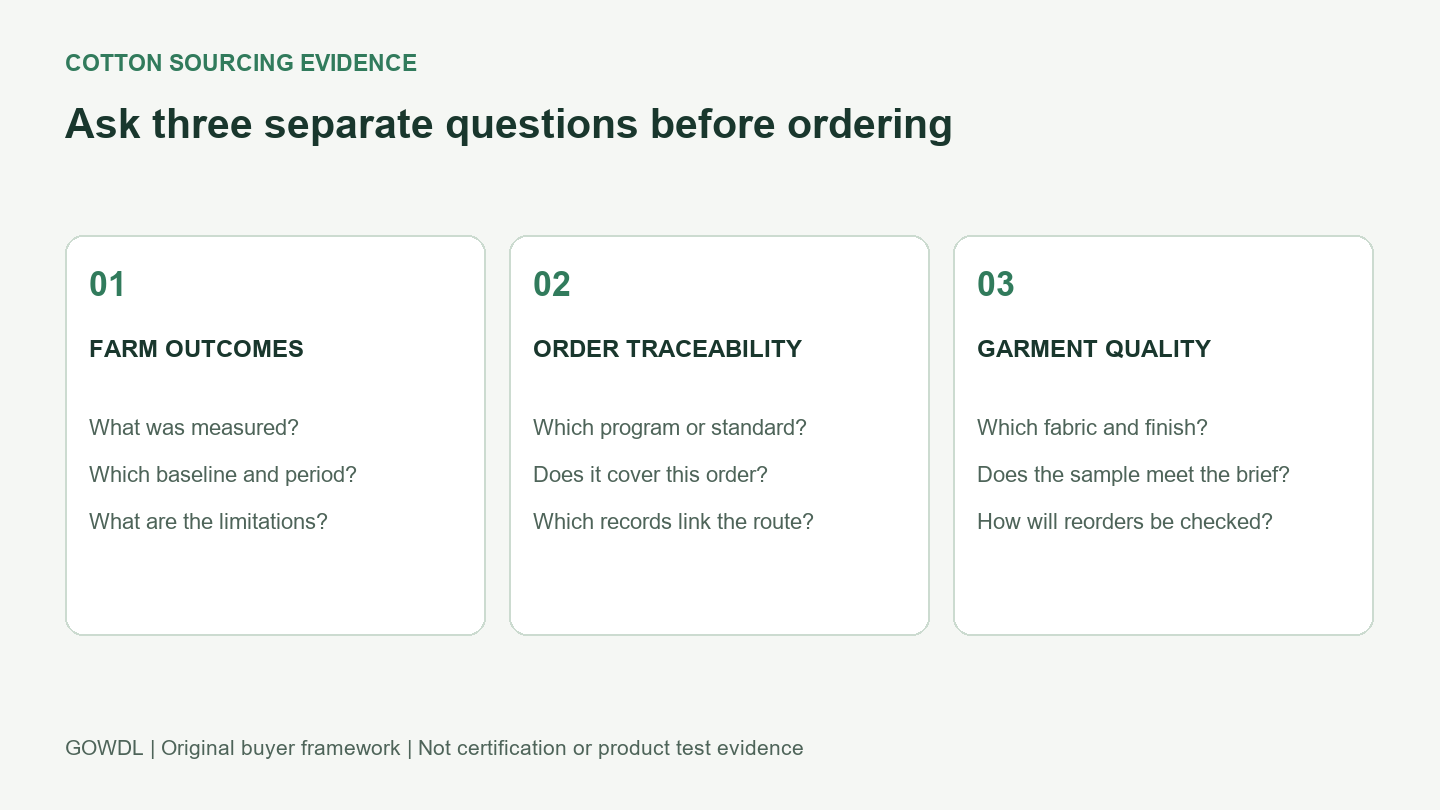
Regenerative cotton vs organic cotton: different questions
Start by asking which standard or program a supplier means. A generic regenerative description is not interchangeable with U.S. Regen Cotton, and neither should be assumed to mean certified organic. Avoid accepting a quotation that uses all three terms as synonyms.
For organic sourcing, Textile Exchange’s Organic Content Standard addresses third-party verification of organic material and its chain of custody. It does not by itself answer every question about the finished garment. Confirm the applicable certification, product scope and permitted wording for your order.
| Offer description | Clarify before purchase | Do not assume |
|---|---|---|
| Named regenerative program | Program requirements, applicable supply route and substantiation for the proposed claim | Organic status or a product-wide carbon reduction |
| Certified organic cotton | Valid certificate scope, applicable shipment records and product claim requirements | Automatic approval for every seal or finished-product statement |
| Conventional cotton | Composition, origin information, quality specification and any separately supported claims | A particular environmental footprint without relevant data |
| Cotton blend | Percentage and identity of each fiber, including the claimed cotton portion | The cotton claim also covers polyester, elastane, trims or packaging |
USDA’s organic-textiles guidance distinguishes claims about certified fibers from certification of the finished product. It says the USDA organic seal cannot be used to imply finished-product certification where that certification is absent. Before printing labels for the U.S. market, have the proposed wording reviewed against the actual certification and product composition.
Build an evidence file for the actual order
A corporate sustainability presentation is useful background, but it should not be your only purchasing record. Ask the seller to identify the specific material article and explain how the proposed quantity is connected to the claimed sourcing route.
Textile Exchange’s Content Claim Standard illustrates why scope and transaction evidence matter in certified supply chains. Use the documentation system applicable to the chosen program; do not assume Textile Exchange documents establish participation in a different program.
Copy this supplier document checklist
- Exact fiber composition, fabric article code and intended sourcing claim.
- Named program or standard, current certificate details where applicable, and the entities and activities covered.
- Order-linked volume records and an explanation of the supply-chain tracking model.
- Identity of the seller, mill and garment producer involved in the proposed route.
- Rules for product wording, trademarks, logos and any required approval.
- How substitutions, shortages, mixed production and reorders will be handled.
Resolve gaps before issuing an order that depends on a specific claim. For example, if a supplier offers a certified fabric but cannot connect it to the proposed quantity and production route, keep the claim pending. A matching color swatch is not a substitute for those records.
Translate the sourcing brief into a polo or T-shirt sample
Keep fiber provenance and garment performance as separate approval tracks. A program name does not specify the yarn, knit construction, finishing, dimensions or decoration process. Put those choices into a technical brief before comparing quotes.
Compare weight while holding other details steady
A useful sampling exercise is to request 180, 200 and 220 GSM options in the intended construction. These are example comparison points, not universal recommendations or guaranteed stock specifications. Ask for actual weight and tolerances, then assess opacity, hand feel and drape using the same size and approved care procedure.
For polos, examine the collar after laundering, placket alignment, sleeve opening and logo area. For T-shirts, check neck recovery, side-seam movement, print surface and finished measurements. Agree acceptable dimensional change and inspection methods with the supplier; do not invent a pass mark after the samples arrive.
GOWDL’s cotton polo manufacturing options and cotton T-shirt manufacturing options can help structure a product brief. Any special fiber program, certification or environmental claim needs separate confirmation for the proposed order.
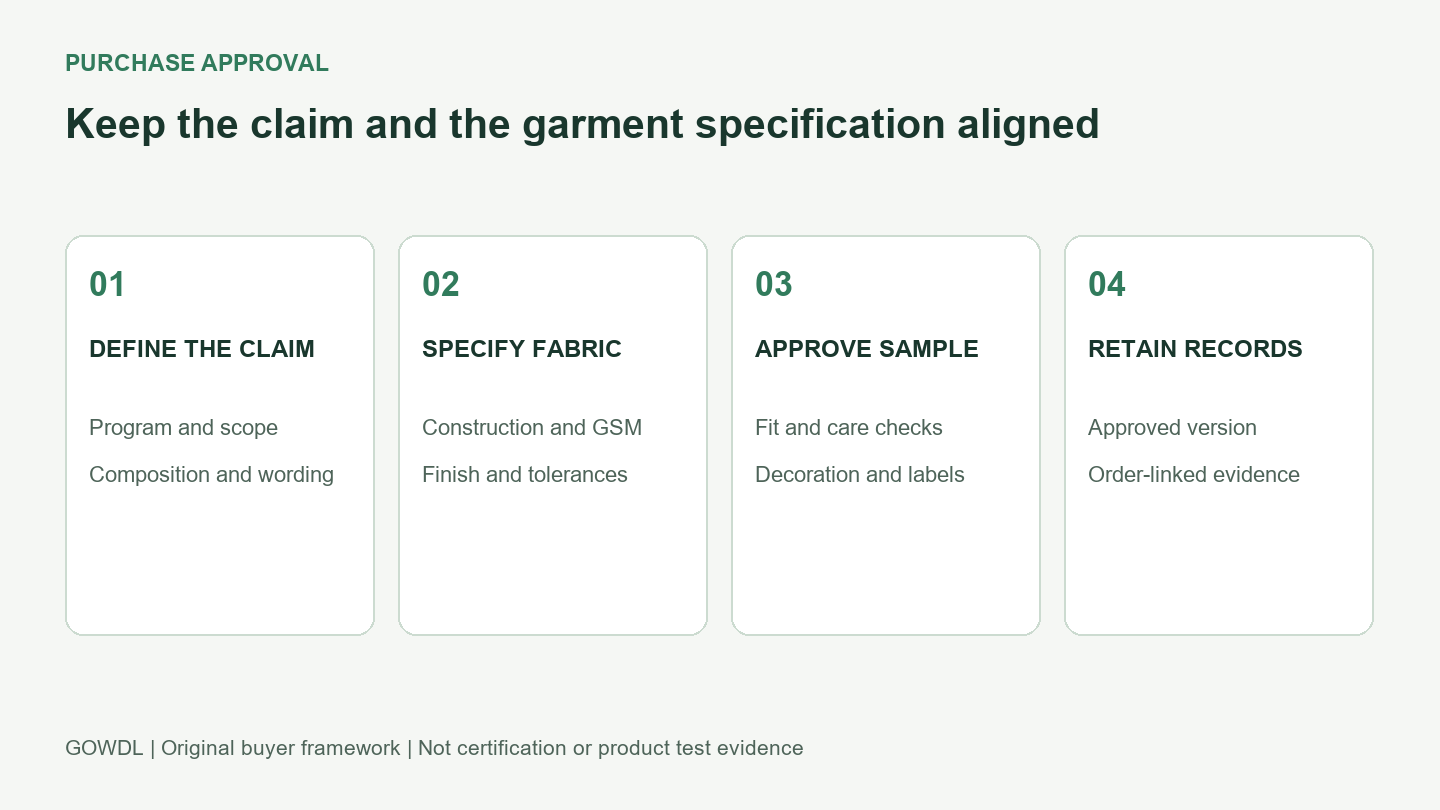
Practical scenario: a hospitality uniform reorder
Suppose a hotel wants to replace its cotton polos while adding a documented sourcing story. Begin with the existing uniform’s measurements and care routine. Approve the required fit and fabric first, then compare a documented special-fiber option against the same brief. Include label approval and repeat-order availability in the comparison.
If continuity matters more than changing the fiber story immediately, review ready-stock polo styles as a separate purchasing option. Existing stock should be evaluated on its own documented composition; this article does not establish that those products contain U.S. Regen Cotton.
Compare the complete quote, including claim-related work
A regenerative or organic sourcing request may change the supplier route, but the name alone cannot tell you the premium or minimum quantity. Request a written quote showing the fabric, garment construction, decoration, packaging, documentation work and delivery terms.
Ask whether the quoted scope includes the needed records, label review and retained samples. Compare sample and reorder lead times as well as the initial price. If documentation is unavailable by the agreed approval date, decide whether to delay the order, use another verified route or remove the unsupported claim before production.
Frequently asked questions
Does regenerative cotton automatically mean organic cotton?
No. Ask for the named regenerative program and any separate organic certification. Evaluate each proposed claim against its own requirements and the order’s documentation. Do not add an organic label merely because a supplier describes its agricultural practices as regenerative.
Will regenerative cotton make the polo softer?
The sourcing description does not establish the finished fabric’s hand feel. Compare actual swatches and garments with the yarn, construction and finish identified. Choose the approved sample against the intended wear and care requirements, while evaluating sourcing evidence separately.
Can GOWDL supply U.S. Regen Cotton garments?
This article does not confirm that specific sourcing route or current stock availability. Send the required program, product specification, quantities and documentation needs for review. Supply feasibility and any product claim must be confirmed for the order before a purchase commitment.
Make the sourcing story verifiable
U.S. Regen Cotton 2026 is a useful news entry point for better cotton sourcing decisions. For a commercial order, connect the claim to the material, check the evidence and approve the garment. Keep those decisions visible in the purchase specification and repeat-order records.
Developing cotton apparel for your team or brand? Explore GOWDL’s cotton polo manufacturing solutions or shortlist ready-stock polos. Share your fit, fabric, quantities and sourcing documentation requirements to start a practical quotation discussion.
Sources checked October 16, 2026. Environmental figures are attributed program results, not GOWDL product measurements. The checklists and hospitality scenario are editorial guidance, not a claim of certification or a completed customer case.
