
NUSPUN Active Comfort technology in 2026 brings a useful sourcing question into focus: how much weather protection does a garment need before it starts compromising the wearer’s intended activity? For performance apparel brands, teamwear distributors and outdoor uniform buyers, the answer belongs in the product brief before a membrane or fabric is selected.
The new material announcement is a starting point. The purchase decision still needs an identified laminate, comparable test evidence and a finished garment sample. Here is how buyers can evaluate the news and translate it into practical development requirements.
What is new about NUSPUN Active Comfort in 2026?
Niber Technologies’ October 13, 2026 announcement introduces NUSPUN laminates based on its electrospun nanofiber technology. The company describes a tunable balance of breathability and weather protection, rather than a single construction for every application.
Its stated rollout begins with selected brand partners in Q4 2026, with the first incorporating garments expected in Fall/Winter 2027 collections. That distinction matters when planning samples, production and a retail launch. The announcement does not establish immediate general availability or GOWDL stock access.
For a buyer, the next step is an article-specific discussion: which face fabric, membrane, backing and finish are proposed, and what evidence covers that combination? Keep future development opportunities separate from materials actually being quoted for the order.
Arcus, Ventus and Stratos: match the direction to the brief
Niber describes three initial platforms in its announcement. These are the company’s positioning statements; the purchasing questions are our editorial framework.
| Platform | Company-stated focus | Question before sourcing |
|---|---|---|
| Arcus | Breathability with waterproof protection for demanding weather | Which reports cover the exact laminate and proposed garment assembly? |
| Ventus | Breathability, wind protection and water resistance during activity | What exposure, activity and layering arrangement are being specified? |
| Stratos | Air permeability and water resistance for high-output activity | What airflow conditions and weather limitations apply to the quoted article? |
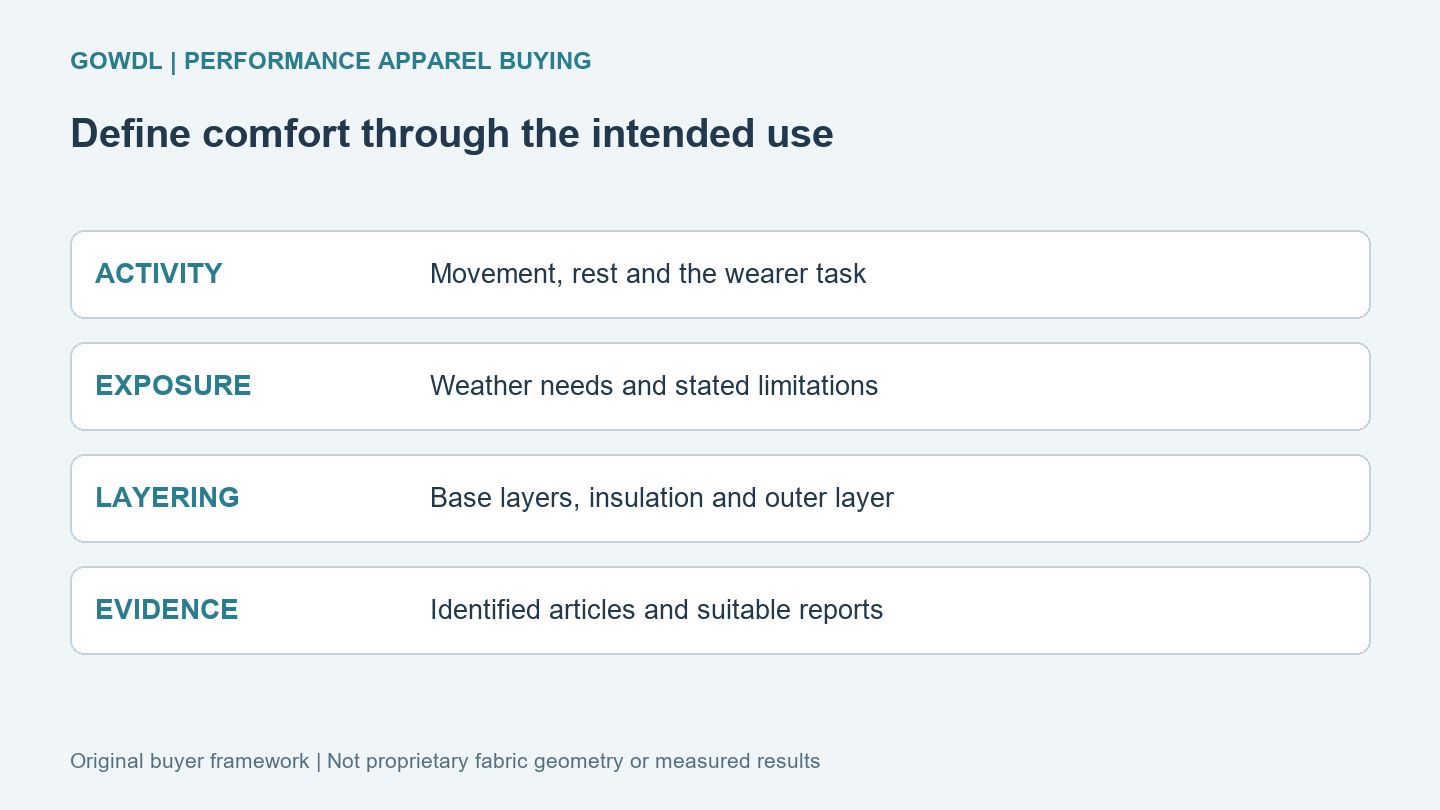
Do not turn these descriptions into a universal ranking. A shell for prolonged exposure, a cycling layer and a team warm-up jacket can require different balances. Start with the wearer’s task, expected exposure and layering arrangement, then ask the supplier to propose a suitable identified article.
Separate airflow, water-vapour resistance and water protection
“Breathable” is too broad to serve as the entire performance specification. Request the measured property, method, conditions, specimen identity and units. Ask whether the result covers an isolated membrane, a finished laminate or a garment assembly. Compare like-for-like evidence before approving a claim.
Air permeability: identify the test conditions
ISO 9237 describes a method for measuring fabric permeability to air. When a supplier quotes an airflow figure, request its test method, pressure difference, test area and unit basis. A number presented without those details should prompt clarification rather than an immediate comparison with another supplier’s figure.
Ask which part of the finished garment the tested fabric represents. A different lining, panel or reinforcement needs to be accounted for in the brief. Keep laboratory material results beside, rather than in place of, the finished sample assessment.
Water-vapour resistance: request a comparable report
ISO 11092:2026 addresses thermal and water-vapour resistance under steady-state conditions, including multilayer assemblies. ISO explicitly states that those test conditions do not represent specific comfort situations. A laboratory result therefore needs context before it becomes a promise about how every wearer will feel.
If two quotations use different methods or test assemblies, ask the laboratory how to obtain a fair comparison. Avoid converting unrelated breathability figures with an unsupported formula. Record the selected method and acceptance criterion in the technical pack before viewing the final report.
Water protection: connect material and construction evidence
Ask what the supplier means by water resistant or waterproof for the exact proposed article. Identify the test method, conditions, endpoint and any care procedure used before testing. Then ask how seams, closures, pockets and openings will be assessed on the garment. A material report alone leaves those construction questions unanswered.
| Approval topic | Evidence to request | Keep separate |
|---|---|---|
| Airflow | Method, pressure, area, units and tested construction | General comfort or rain-protection promises |
| Moisture transfer | Named method, specimen layers, conditions and result | Unrelated laboratory metrics and wearer observations |
| Weather exposure | Relevant material and assembly evaluations | Membrane data and finished-garment claims |
| Durability after care | Agreed care procedure and repeated checks | New-sample results and post-care results |
Design the whole performance garment around the use case
GSM, membrane type and a platform name do not complete a jacket specification. List the face fabric, membrane, backing, lining, seam treatment, closures and ventilation features. Request a sample that includes the actual logo application and the intended size and fit.
A practical teamwear scenario
Consider a club developing an outer layer for coaches who move between an active warm-up session and time standing beside a pitch. This hypothetical brief should record both periods, the base layers worn and the intended exposure. It should also distinguish a lightweight activity layer from a separate garment intended for prolonged bad weather.
Compare samples during the same defined tasks with the same layers. Record fit, restriction, ventilation access and observations during movement and rest. Repeat the agreed assessment after care. These notes help select a garment; they should not be presented as independent laboratory ratings or proof of a universal comfort range.
GOWDL’s active-insulation sourcing guide addresses the related layering question. Insulation and a weather-facing laminate have different roles, so identify both when the product brief includes warmth as well as exposure protection.
Approve decoration and panel transitions
Test the intended print, embroidery or transfer on the actual proposed construction. Agree on placement and review appearance after the selected care procedure. Inspect panel junctions, pocket attachments and areas where reinforcement changes the feel. Ask suppliers to identify any construction changes needed for the material instead of silently adopting their standard jacket specification.
What should performance apparel buyers put in the RFQ?
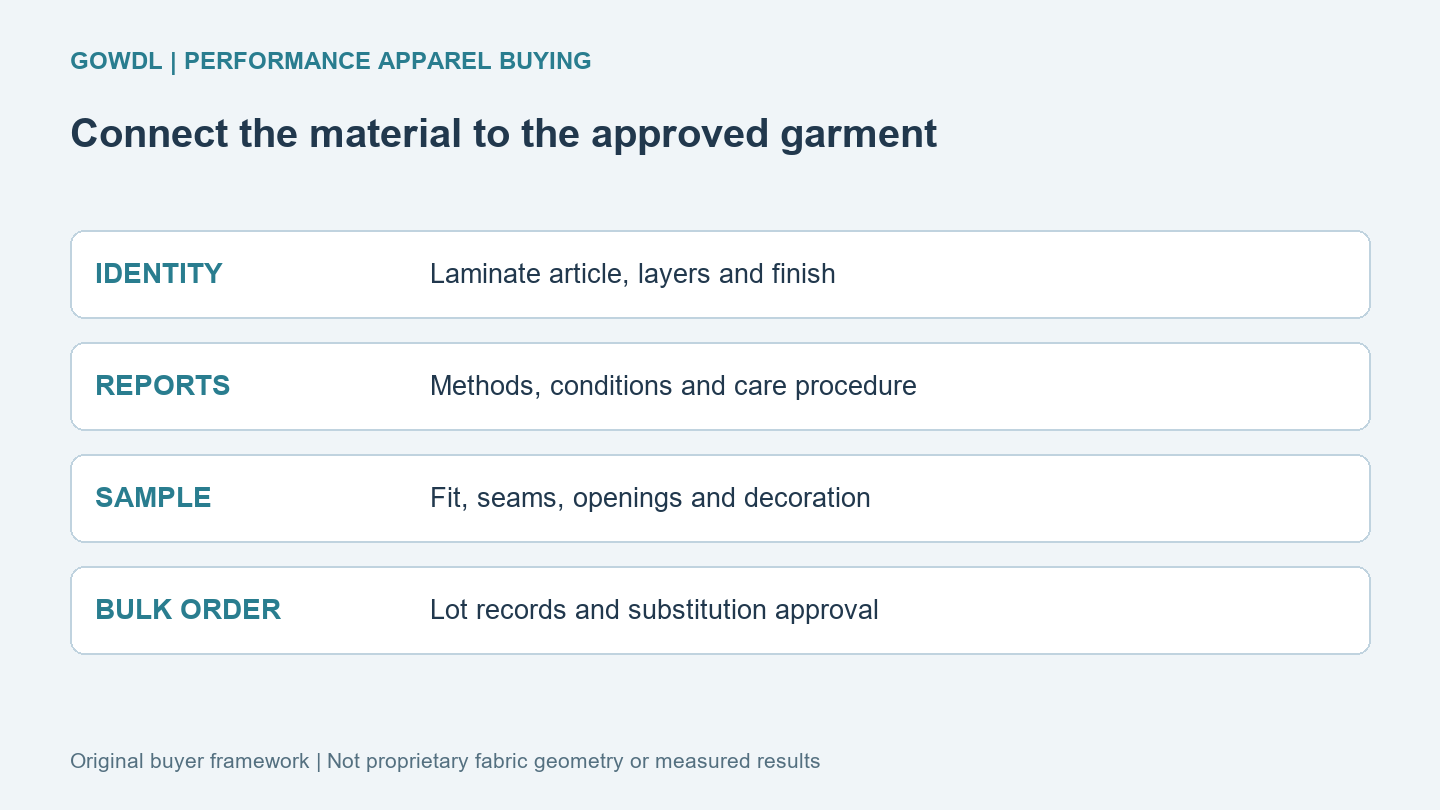
- Use: activity pattern, exposure, layering and intended product claims.
- Material: exact laminate article, full construction, composition, finish and GSM.
- Evidence: methods, specimen identity, care conditions and agreed acceptance criteria.
- Garment: fit, seams, openings, pockets, ventilation and decoration.
- Commercial terms: sample and production quantities, colors, size mix, costs, timing and delivery basis.
- Continuity: article availability, batch records, substitution approval and reorder checks.
Niber states that its membranes and laminates are manufactured without intentionally added PFAS materials. Keep that supplier statement in its stated scope. Ask for order-specific declarations covering the components being purchased and have any market-specific requirements reviewed by the responsible specialist. Do not rewrite it as an unsupported guarantee about every chemical in a finished garment.
For an own-label project, use GOWDL’s custom jacket manufacturing page to start the construction discussion. For an independent stock-based route, browse ready-stock clothing. Confirm the available article, quantity and evidence separately; a stock listing does not establish use of NUSPUN.
Frequently asked questions
Is Active Comfort a standardized test rating?
Do not treat a positioning phrase as a complete test specification. Ask for the measured properties and relevant methods for the identified article. A useful approval file links the intended use to the reports, construction details and finished sample that support the purchasing decision.
Should every running or teamwear jacket use the most protective option?
Choose against the intended activity and exposure, with clear limitations in the brief. Avoid selecting a material solely because one advertised number is higher. Compare identified samples and suitable evidence, and decide which requirements matter most for the product’s actual role.
Can GOWDL supply NUSPUN fabric now?
This article does not confirm availability, authorization or a supply relationship. Submit the exact branded-material requirement, design and quantities for feasibility review. Confirm sourcing, permitted branding and supporting documentation before including a third-party technology in a quotation or product claim.
Turn a new material announcement into a stronger buying brief
NUSPUN Active Comfort technology gives performance apparel buyers a timely reason to separate material promises from garment requirements. Define the use case, request comparable evidence and approve the complete assembly. Keep special-material availability and production timing explicit before committing to a launch.
Looking for custom performance apparel for your own team or brand? Explore GOWDL’s custom sportswear and outerwear manufacturing solutions. Share the intended activity, design, quantities and performance brief so the available development routes can be assessed.
Sources checked October 19, 2026. News context: Niber Technologies’ October 13 announcement. Product positioning and availability statements are attributed to the company; no independent product testing is presented. Diagrams and purchasing examples are original editorial material. NUSPUN is a third-party brand name; no affiliation, authorization or GOWDL stock availability is implied.
