
Samsara Eco’s 2026 apparel recycling research points clothing brands toward a purchasing issue that comes before end-of-life processing: will the garment remain useful long enough to justify making it? Recycled content, durability and a credible recovery route belong in the same product brief, but each needs its own evidence.
The relevant new research is the company’s Circular-Conscious Consumer Report. It examines consumer expectations and responses to quality problems; it is not a newly published laboratory study proving that every fabric can be recycled. For apparel brands and wholesale buyers, its value is in improving specifications, approval checks and the information shared with customers.
What Samsara Eco’s 2026 research actually measures
The official report announcement is dated October 8, 2026. Samsara Eco surveyed 5,208 members of its Sam for Change community across 120 countries online between July 22 and August 23. Respondents were self-selected: 86.7% were aged 18–24 and 75.8% identified as female.
That makes this an engaged-community survey, not a representative sample of all clothing customers. Its frustration questions allowed up to three choices; those answers describe what bothers respondents, not measured factory defect rates. Treat the results as questions to investigate in your own customer base rather than a forecast of your brand’s returns or sales.
What clothing brands can learn from the findings
The figures below come from the same company-published research. Purchasing actions are our editorial interpretation, not interventions tested by the survey.
| Reported finding | Share of respondents | Purchasing question to investigate |
|---|---|---|
| Selected leaving the brand after garment failure | 27.7% | Do your feedback channels capture dissatisfaction beyond returns? |
| Selected returning the failed item | 5.9% | Are returns being mistaken for the complete quality picture? |
| Frustrated by thinning fabric or holes | 62% | How will the proposed fabric be assessed for the intended use? |
| Frustrated by splitting or unravelling seams | 55% | Which seam and construction checks belong in approval? |
| Frustrated by pilling | 50% | What surface-appearance evidence is needed before release? |
A practical response is to connect product development with complaints, repair requests and reorder feedback. Ask which problems appear repeatedly and which are missing from current inspection sheets. Do not add these percentages together or convert them into a promised retention benefit from changing fabric.
Make your own feedback easier to interpret
Use consistent categories for fabric damage, seam opening, shape change, surface appearance, decoration and fit. Keep the article, batch, purchase date, reported care and photographs where customers provide them. Separate a reported issue from a confirmed manufacturing fault so the team can investigate without overstating what the evidence establishes.
For wholesale programs, ask distributors and uniform managers how they learn about problems after delivery. A low return count is one data point. A short follow-up questionnaire or a repair log may provide information that a warehouse return report cannot capture.
Where Samsara Eco’s recycling technology fits
Samsara Eco’s technology overview describes enzyme-based depolymerisation: prepared plastic and textile inputs are broken into monomers, purified and made available for new polymer production. The company discusses PET/polyester and nylon 6,6. These are attributed descriptions of its technology, separate from the consumer survey.
For an apparel buyer, a technology’s demonstrated capability is the beginning of a recovery discussion. Ask the intended recycler to evaluate your actual garment specification, including fiber blends, dyes, coatings, labels and trims. Request accepted-input criteria, preparation instructions and a realistic route from collection to processing.
Separate recycled content from future recyclability
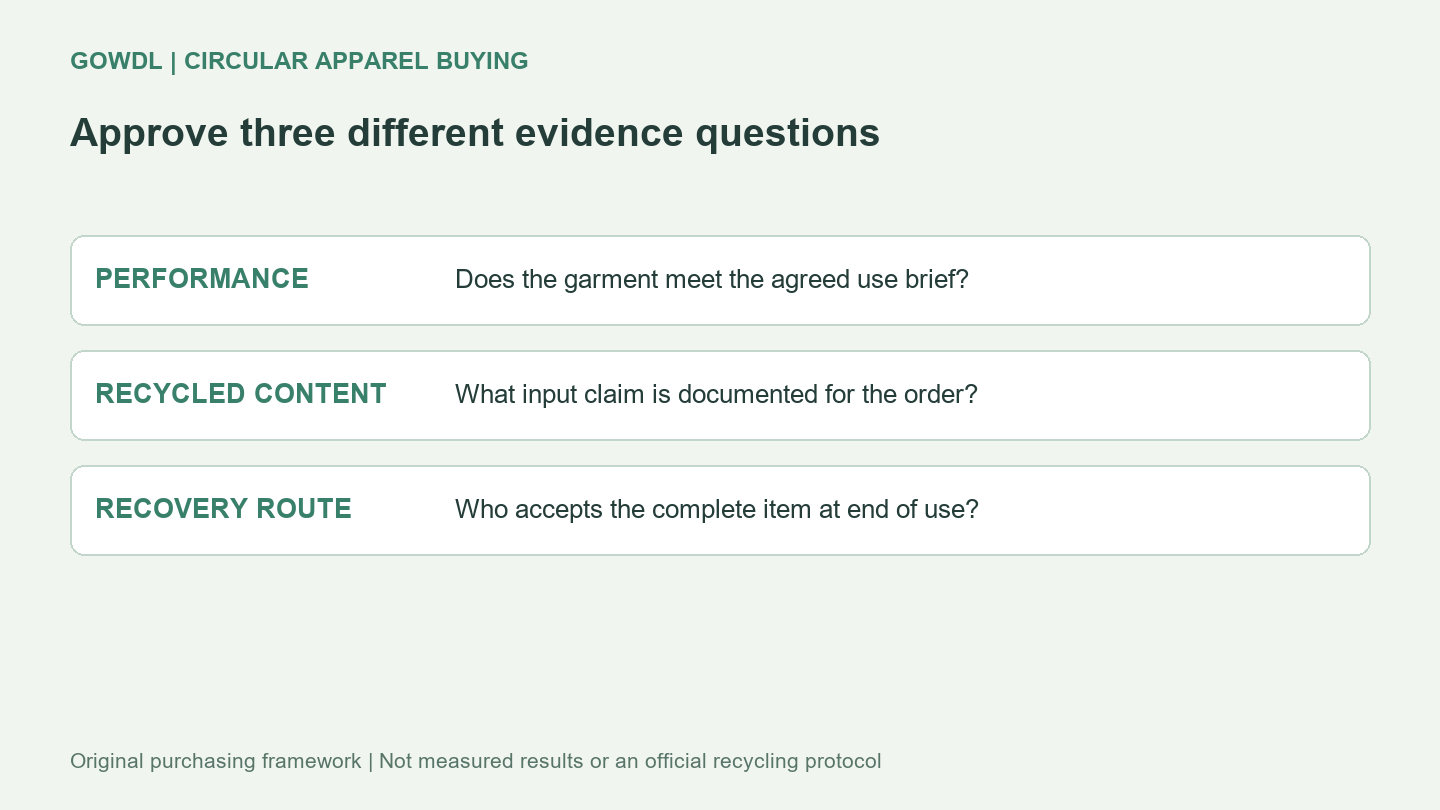
A purchase can contain recycled material without a confirmed system for recovering that finished garment later. Conversely, a proposed recovery route does not establish the recycled percentage in today’s fabric. Keep both requirements explicit in the order and in customer-facing copy.
For a named certified-content claim, Textile Exchange’s Content Claim Standard overview explains the role of supply-chain tracking and scope and transaction certificates. Ask which current scheme and documents support the offered material. Do not use a general supplier certificate as a substitute for checking the order-specific claim.
GOWDL’s textile-to-textile sourcing guide covers another important distinction: the waste input’s description may differ from the finished fiber. Use that distinction when comparing different recycling routes rather than grouping every recovered material under one vague label.
Turn circularity interest into an approvable product brief
Start with the garment’s job and the user’s care routine. Then decide what evidence will support the required performance and material claims. Avoid adopting a universal wear-life promise from a consumer expectation or choosing a test threshold only after seeing the supplier’s results.
| Approval area | Ask the supplier for | Keep in the order file |
|---|---|---|
| Fabric identity | Composition, construction, finish, GSM and exact article | Identified swatch and quotation reference |
| Garment durability | Suitable test proposals and a finished sample | Agreed criteria, reports and care observations |
| Recycled-content claim | Percentage basis, relevant scope and supporting documents | Approved wording linked to the purchased material |
| Repair and recovery | Component information and proposed service arrangements | Confirmed responsibilities and recovery-partner acceptance |
| Reorders | Lot references and a substitution approval procedure | Change history tied to the approved sample |
Check the decorated garment after agreed care
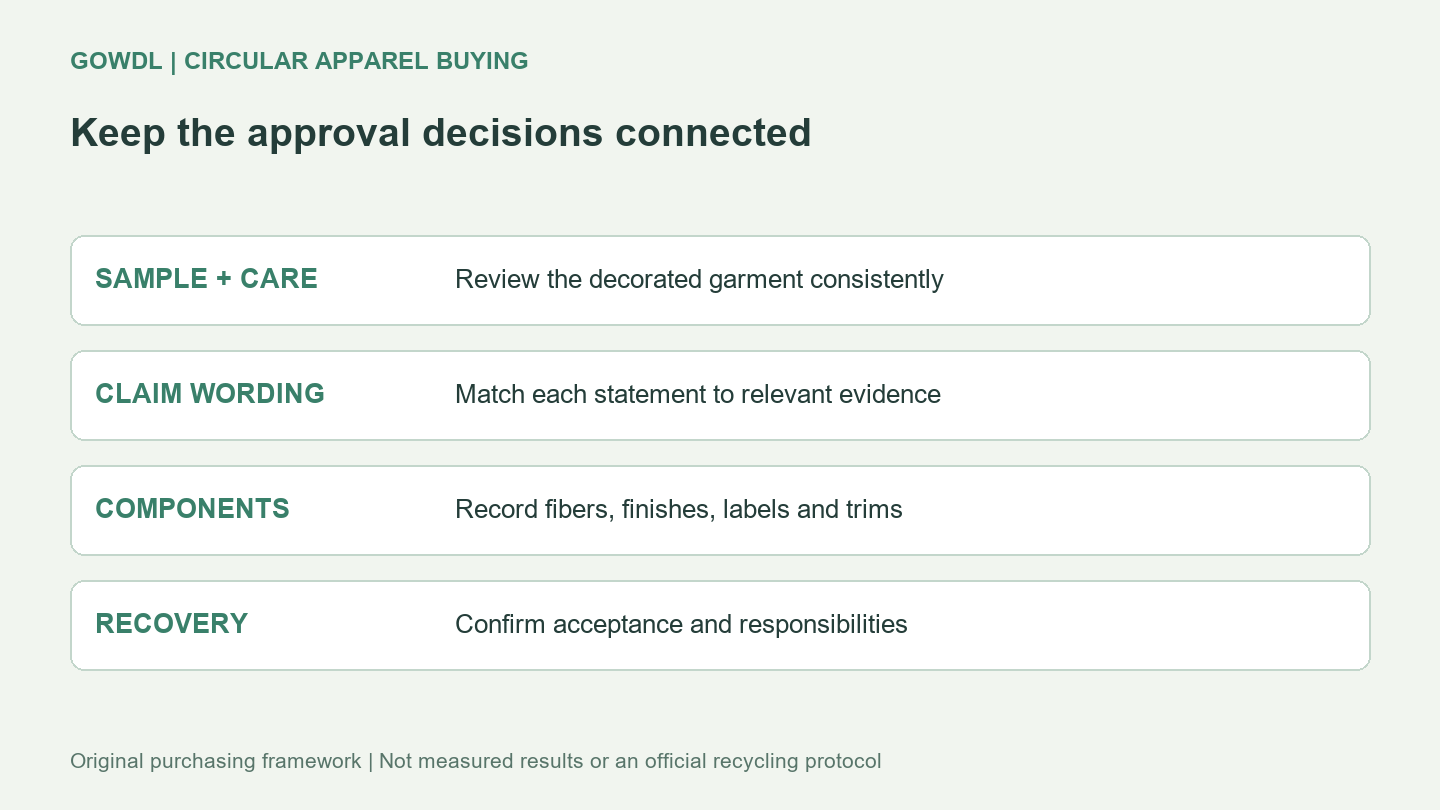
Include the real logo method, collar, cuffs, pockets and labels in the sample. Define the care procedure before comparison and record measurements and appearance consistently. If a property requires laboratory evidence, obtain a relevant report for the identified material or assembly. An informal wear check should complement the evidence plan rather than become an unsupported certification claim.
Practical scenario: a recycled-content uniform polo
Imagine a uniform distributor considering a recycled-polyester polo for hospitality staff. The buyer wants a consistent appearance, clear material information and a possible end-of-use route. This is an illustrative scenario, not a GOWDL customer case or a claim that any particular polo is accepted by Samsara Eco.
Begin with an approved conventional reference and one identified alternative. Compare fit, collar shape, seam appearance, surface change and logo quality using the same agreed care routine. Put recycled-content approval in a separate box requiring the relevant evidence. A good-looking sample should not automatically approve its environmental description.
Next, list every component and ask a proposed recovery partner what it accepts. Resolve sorting, collection, transport and preparation responsibilities before announcing a take-back promise. If the route is not confirmed, keep the marketing to the verified material claim and the care guidance the brand can actually provide.
For product development, GOWDL’s polyester polo manufacturing page provides a starting point for a uniform brief. Brands working on a different staple can review custom T-shirt options. Material route, testing and documentation requirements should be confirmed for the individual project.
A short checklist before the bulk purchase order
- Identify the fabric and every relevant component.
- Agree on the intended use, care and performance checks.
- Approve the decorated sample and record unresolved issues.
- Match material claims to the appropriate order evidence.
- Confirm repair or recovery arrangements before promising them.
- Define when a fabric, mill or component change requires reapproval.
Frequently asked questions
Is this a new laboratory study of enzyme recycling?
The 2026 report discussed here is consumer research about quality expectations and circularity. Technical claims about a recycling process require separate evidence. Keep a consumer’s reported frustration distinct from laboratory results, plant capabilities and acceptance of a specific finished garment.
Do the findings prove that recycled fabrics wear out faster?
No such comparison is established by the findings presented here. Assess candidate fabrics against the same use brief and suitable methods. Ask for identified material reports and finished-sample checks rather than inferring durability from whether the input is recycled or virgin.
Can GOWDL offer Samsara Eco materials or take-back processing?
This article does not establish access, authorization or a recovery partnership. Submit the required material and evidence brief for feasibility review. Any branded supply route or take-back arrangement needs separate written confirmation before it appears in a purchase order or product promise.
Build circular apparel around products worth keeping
Samsara Eco’s 2026 research gives clothing brands a reason to connect quality control with circular-material sourcing. Use the survey to improve questions and feedback channels. Let identified fabric evidence, approved garments and confirmed recovery arrangements support the final decisions.
Looking for custom performance apparel for your own team or brand? Explore GOWDL’s custom polo manufacturing solutions, or browse ready-stock clothing for a separate stock-based purchase. Share the design, use case and documentation requirements; the stock links do not establish recycled content or participation in a particular recycling program.
Sources checked October 19, 2026. Consumer-report announcement: October 8, 2026. Survey figures are attributed to Samsara Eco and apply to its described sample. Examples, diagrams and buying recommendations are original editorial material. No independent product testing, customer case, third-party affiliation or GOWDL material certification is implied.
