
CIRCULOSE sourcing starts with a distinction that can change your purchase order: a material recovered from cotton textiles does not necessarily become cotton fiber in the next garment. Buyers developing T-shirts, polos and casual layers need to identify the finished fiber, the recycled share and the documentation behind the claim before comparing quotations.
Textile Exchange’s October 2026 awards bring this issue into focus. The useful question for a clothing brand is how to turn a promising recycling story into an identified fabric, an acceptable sample and a supportable product description.
What changed in October 2026?
On October 15, Textile Exchange announced its 2026 Climate and Nature Impact Awards winners. The CIRCULOSE Recycling Ecosystem received the Textile-to-Textile Ecosystem Award. The announcement describes brand volume commitments and fiber-producer partnerships supporting the recycling operation’s restart.
That is evidence of recognition for a supply-chain collaboration. It is not a finished-garment test report, a quotation or a guarantee of available fabric at your order quantity. A buyer should follow the story upstream and downstream: who supplies the input, who makes the fiber, and which mill produces the fabric being offered?
This guide uses that October 15 announcement as its news context. The purchasing workflow below is original editorial guidance, not a report of GOWDL trials, an endorsement of a quoted supplier or a claim that an award-winning material is already in our garments.
CIRCULOSE sourcing: compare the material routes first
According to Circulose’s own FAQ, CIRCULOSE is dissolving pulp made from discarded cotton-rich textiles. Fiber producers can use it in viscose and lyocell production. The pulp is a raw material rather than a ready-to-cut fabric; subsequent fiber, yarn and fabric decisions still matter.
Keep quotations under separate headings until their composition and processing route are clear. The table is a comparison framework, not a performance ranking or a list of products confirmed available from GOWDL.
| Quoted route | Identify before comparing | Question for the buyer |
|---|---|---|
| Mechanically recycled cotton blend | Cotton proportion, reclaimed input, yarn and fabric article | Does the approved knit meet appearance and durability requirements? |
| Regenerated cellulosic fiber using recycled pulp | Finished fiber type and documented recycled input share | Is the proposed garment description consistent with the actual composition? |
| Conventional cotton reference | Cotton composition, knit, finish and weight | What changes when the candidate replaces the existing reference fabric? |
| Mixed-fiber garment | Every component’s composition and its role in the claim | Which part of the item does the recycled percentage describe? |
A cotton-rich waste input and a cotton-rich finished garment are different statements. Ask suppliers to show both the proposed fiber label and the separate recycled-content wording. A familiar word such as “cotton” in the origin story should not replace the actual fiber description in the technical pack.
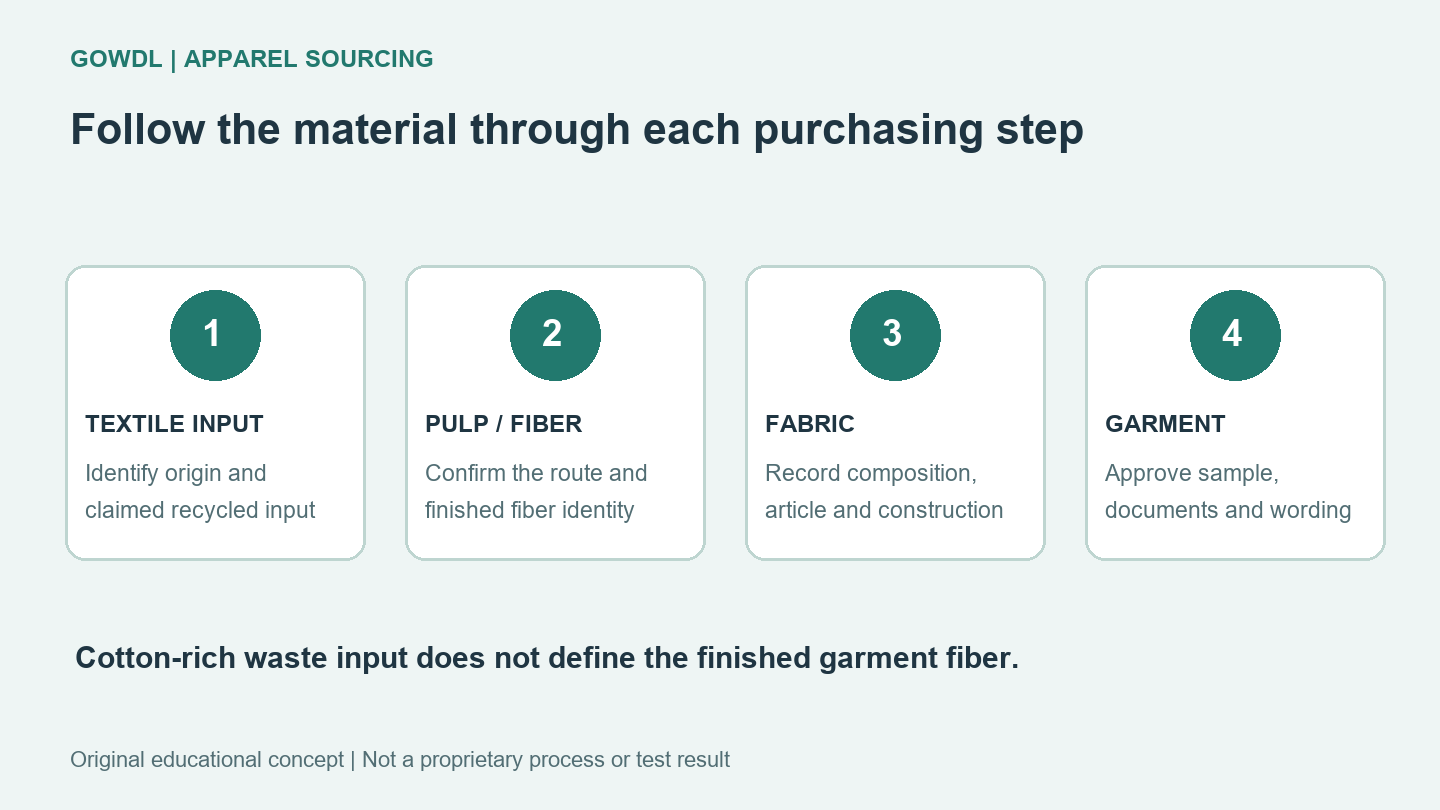
Separate component percentages from garment claims
When a supplier writes “recycled blend,” ask for a calculation with a clear denominator. Does the percentage refer to a fiber input, one fabric, the main body panels or the complete garment? Keep those answers beside the quotation rather than leaving them in a sales conversation.
A simple purchasing example
Consider a hypothetical fabric containing 60% fiber A and 40% cotton. If the documents establish that half of fiber A’s mass is attributable to recycled input, its contribution is 60% × 50% = 30% of that fabric’s mass. This arithmetic example assumes no other recycled contribution; it is not a CIRCULOSE product specification, certification calculation or approved label claim.
If a hoodie then adds a different hood lining, rib, pocket bag and trims, do not automatically carry that fabric-level figure onto the complete item. Request a component breakdown and ask the responsible certification or claims specialist to confirm the appropriate calculation and wording.
Match documentation to the actual order
Textile Exchange explains that its Content Claim Standard uses supply-chain controls and scope and transaction certificates to support verified material tracking. For a certified order, ask which current standard and claim rules apply and which documents will accompany the shipment.
Do not stop at a certificate displayed on a website. Record the company, site, relevant product scope, validity and order documents that the supplier proposes to provide. Have unclear scope or wording checked before approving packaging. A fabric’s hand feel cannot substitute for this paper trail.
Approve the intended garment, not the recycling story
Write down the product’s job before requesting swatches. An everyday retail tee, a hotel uniform polo and a casual hoodie can have different fit, care and presentation requirements. The material story is one requirement alongside those needs, rather than the only approval criterion.
T-shirts: compare fit and decoration after care
Ask for a sample in the proposed knit, color and finish, with the actual print or embroidery. Agree on the care procedure and measurements to record before evaluating it. Check body length, width, twisting, neckline shape and artwork appearance against the approved reference. A generic swatch without the decoration leaves part of the decision unresolved.
Polos: include collars, plackets and rib
A main-body fabric substitution is not a complete polo specification. Include collar and cuff materials, placket reinforcement, seam appearance and logo placement in the development brief. Compare the full garment after the proposed care routine, especially where different components meet. Use GOWDL’s fabric guide to organize baseline construction questions before requesting an alternative.
Hoodies: account for every material panel
For a layered or brushed style, identify the face, back, lining and rib separately. Record which parts use the proposed recycled-content material and which retain the reference construction. Request a finished sample so the team can assess drape, hood shape, pocket behavior and decoration together rather than approving unrelated swatches in isolation.
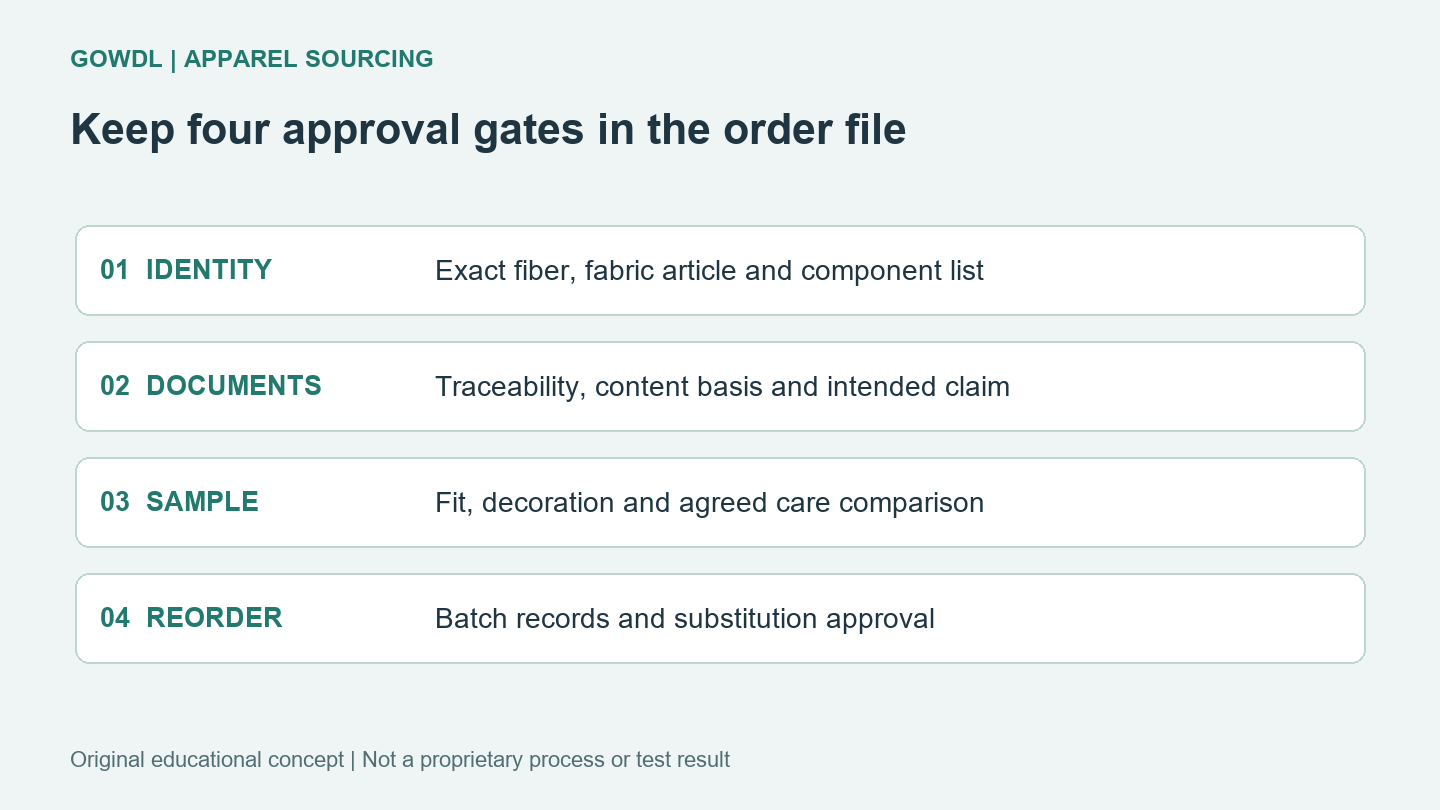
Use one RFQ to make supplier answers comparable
Sending the same brief to each supplier makes gaps easier to identify. Request written answers against the fields below, including explicit exclusions. Separate the material-development quotation from any stock-based alternative so a deadline-driven fallback does not quietly change your content claim.
| RFQ field | What to request | Approval record |
|---|---|---|
| Material identity | Fiber types, proportions, fabric article, knit, finish and GSM | Identified swatch linked to quotation |
| Claim evidence | Recycled share, calculation basis, applicable documents and wording | Evidence owner and unresolved questions |
| Garment validation | Sample, decoration, care procedure and agreed checks | Signed reference sample and measurement notes |
| Commercial feasibility | Quantity, colors, sizes, sample timing, production timing and delivery basis | Written quote tied to the approved specification |
| Reorders | Article continuity, substitution procedure and batch identification | Reapproval triggers recorded in the order |
Practical scenario: a brand testing a new tee
Suppose a brand wants a recycled-content version of an existing retail tee. Keep the current approved tee as the reference. Ask for one clearly identified candidate, matching decoration and a documented care comparison. Put the fabric and claim decisions into separate approval boxes: an attractive sample may still lack traceability, while complete documents do not guarantee the preferred fit.
Release the development order only after both boxes are resolved. If timing is too tight, consider a separate conventional-stock purchase with accurate product copy. GOWDL’s ready-stock clothing and stock polo collection can provide starting points for that discussion. These links do not identify CIRCULOSE-containing or certified recycled stock.
Frequently asked questions
Does a recycled cotton input mean the finished garment is cotton?
Not necessarily. Confirm the finished fiber type and composition rather than copying the waste-input description onto the label. Keep the input-origin story separate from the garment’s fiber declaration.
Does the 2026 award prove lower impact for my order?
No order-specific footprint follows from an award alone. Request evidence covering the proposed material and comparison if you plan an environmental-impact claim. This article provides no quantified carbon, water or cost saving for a garment.
Can I order CIRCULOSE garments from GOWDL now?
This guide does not confirm branded-material availability or a commercial relationship. Submit the exact material requirement for feasibility review. Confirm sourcing, documentation and any trademark permissions before placing an order or using branded language in marketing.
Turn circular-material interest into an actionable brief
Use the 2026 award as a reason to ask better sourcing questions. Identify the fiber route, document the relevant recycled share, approve the complete garment and define what happens if the fabric changes at reorder. Those steps make the discussion useful beyond a sustainability headline.
Planning a T-shirt or polo program for your brand? Explore GOWDL’s custom T-shirt manufacturing options and share your design, composition target, quantities and evidence requirements. Ask for a stock alternative separately when timing matters, so the final purchase matches the approved brief.
Sources checked October 17, 2026. News context: Textile Exchange’s October 15 announcement. Material definitions are attributed to Circulose. Examples and diagrams are original editorial guidance, not test results or customer case studies. Third-party names identify their respective materials and organizations; no affiliation or authorization is implied.
